
Most employers think carefully before inviting sixteen year olds onto their site. Sellafield had to think harder than most, given its site is a nuclear facility. Its first T Level placement pilot shows what is possible when that caution is worked through properly, rather than used as a reason not to start.
At September’s Next Gen Makers online meet-up, Mark Warrilow of the Gatsby Charitable Foundation set out what makes T Level placements different, before Marc Skillen, Education and Skills Manager at Sellafield, shared how the organisation designed, ran and learned from its own pilot.
What is a T Level industry placement?
A T Level industry placement amounts to at least 45 days, or 315 hours, with a single employer, typically delivered through day release or block release. This placement is what most clearly sets T Levels apart from other qualifications.
The Gatsby Foundation, established almost 60 years ago by Lord David Sainsbury and known for the Gatsby Benchmarks, has worked on technical education reform for the past decade, including with energy sector organisations such as Sellafield.
“If there is a call to action in all of this, it is to get onto the T Level website and make contact with local providers. Please do not wait, because another academic year may slip past without any action” says Mark Warrilow of the Gatsby Charitable Foundation.
Starting cautiously, and quickly rethinking it
Sellafield employs around 13,000 people across West Cumbria and Warrington, and already runs one of the sector’s largest early careers operations, bringing in 400 to 450 people a year across apprenticeships and graduate schemes.
Even so, Education and Skills Manager Marc Skillen admits the organisation was initially hesitant about bringing school-age students onto a nuclear site.
“We were genuinely dubious at the start, but when we looked at it properly, we realised we already bring vocational apprentices onto site at sixteen and seventeen. So why not this” says Marc.
Designing the placement properly
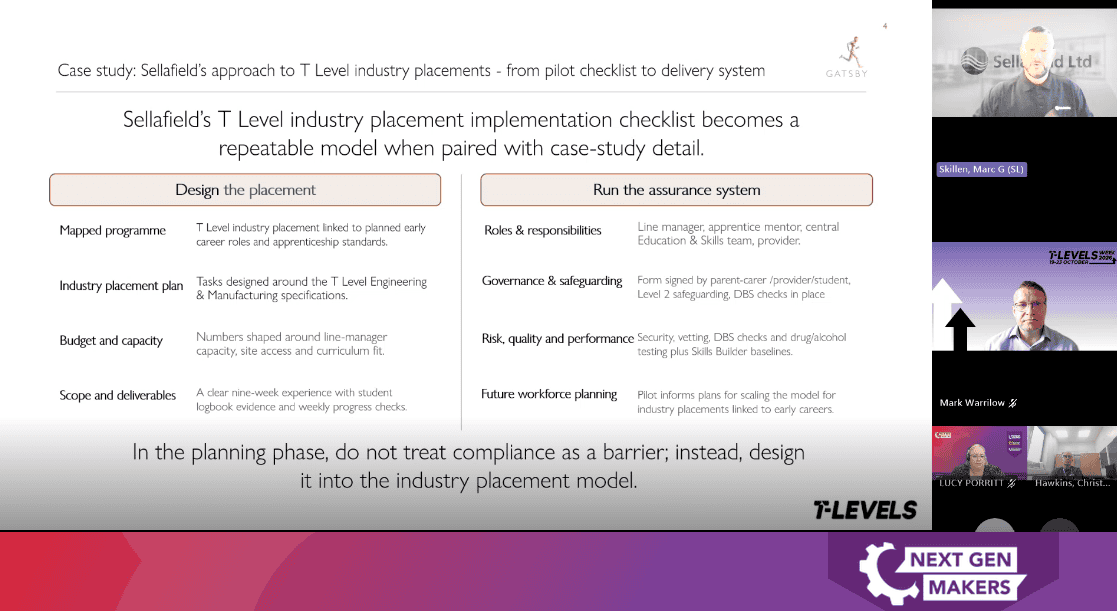
Sellafield piloted the approach with three T Level students, two in engineering and one in digital, mapping their work directly against each T Level specification. Costs were kept deliberately low: a laptop and PPE per student, with no additional payment.
Safeguarding was built in from the start, with line managers required to complete STEM Ambassador checks, and students never left unsupervised.
Only second-year students were taken on, partly for maturity and partly because under-17s cannot access the site. A legal contract, built from a government template and reviewed by Sellafield’s legal team, was signed by the student, their parents and the training provider.
Real work, not observation
Students reviewed design drawings, then went onto the plant to check them against the actual equipment, alongside weekly thirty-minute check-ins mapping progress against T Level standards and a skills benchmark taken at the start and end of the placement.
“These students started delivering genuinely meaningful and helpful work, which is not something people always expect from a work placement” adds Marc.
The results – feeding apprenticeships
All three pilot students progressed: one onto a Level 3 vocational craft apprenticeship, one onto a degree apprenticeship in control systems, and one into an apprenticeship with a Sellafield supply chain company.
Students who performed well were offered a direct route onto the apprenticeship scheme, skipping the full application and interview process.
Sellafield has since advertised eight new placements for next April, delivered on a rolling nine-week basis.
Frequently Asked Questions
Do employers need to pay T Level students?
No. Marc says Sellafield covered only a laptop and PPE per student and chose not to provide additional payment, though employers can choose to pay if they wish.
Can a T Level graduate still go on to do an apprenticeship?
Yes. According to Mark Warrilow of the Gatsby Foundation: “Where there is enough new learning involved, a T Level graduate can move onto a relevant Level 3 apprenticeship, with existing learning credited to shorten the apprenticeship programme.”
Where to start
Sellafield’s pilot shows that even in a highly regulated environment, a well-designed T Level placement can become a genuine pipeline into apprenticeships.
Sessions like this happen every month inside the Engineering Apprenticeships: Best Practice Programme. Request more information to learn more about how you can get involved.