
The UK engineering and manufacturing sector is facing a skills shortage that is not going to fix itself. Make UK’s 2025 Industrial Strategy Skills Commission identified 55,000 long-term unfilled vacancies in manufacturing, costing the economy an estimated £6 billion in lost output each year. 42 per cent of manufacturing vacancies are now classified as skills-shortage vacancies, up from 29 per cent in 2017. 36 per cent of the UK manufacturing workforce is over 50, meaning the retirement pressure is compounding.
Employers waiting for the external recruitment market to solve this problem will be waiting a long time. The employers who will come out ahead are the ones building their own solutions, now.
At the June Next Gen Makers online meet-up, one employer set out the framework they built to do exactly that.
Accrofab, a precision sheet metal fabricator supplying the industrial gas turbine and aero markets, went from having no defined apprenticeship plan two years ago to running a structured competency-based programme across 101 identified competencies covering every process on site. This is how they did it, and why it addresses the skills shortage at source.
Why the traditional recruitment market fails engineering
The engineering skills shortage is not a story about missing candidates, it’s a story about the mismatch between what employers need and what the traditional market can produce.
Precision engineering skills are highly specialist. A composites technician, a multi-axis laser operator, a certified welder…none of these can be trained overnight. And in rural manufacturing locations, where much of UK industry sits, the candidate pool is even smaller.
Accrofab’s Ulster site sits on an industrial estate 20 miles outside Birmingham. In practical terms, it is much further. As Engineering and Product Quality Manager Finlay Bellerby noted at the June meet-up, the site’s operations director lives a 10-minute drive down the road but faces a two-hour commute by public transport. That is a common shape of challenge across UK manufacturing.
It is one of the reasons employers who wait for skilled candidates to appear from the recruitment market often find themselves waiting indefinitely. Meanwhile, the business grows. Accrofab’s Ulster site has grown 50 per cent in the last five years, by both revenue and headcount. The gap between the skills the business needs and the skills the traditional market can supply widens each year.
The response, for employers who take a strategic view, is not to keep trying to hire your way out. It is to build your own pipeline. That means apprenticeships. And it means structured, well-designed apprenticeships that actually work.
What proactive engineering apprenticeship design looks like
Building an apprenticeship scheme from scratch is not the same as bringing on a couple of apprentices and hoping for the best. Proactive scheme design starts with a strategic decision about what the business will need the workforce to look like in five years, and works backwards from there.
Two years ago, Accrofab did not have a defined apprenticeship plan. As Finlay put it at the meet-up:
We didn’t have a structure. We didn’t have a routine. Although our operations director had come through an apprenticeship 25 years earlier, it was very much ad hoc, our decision to bring apprentices into the business.
The turnaround started with a specific strategic goal: three new apprentices every year, brought in on a defined plan, exposed to every capability on site, and developed to be able to fulfil the needs of the business in each process. That plan is now delivering. By September 2026, the Ulster site will have 11 apprentices in-post from a total workforce of 176.
The mechanism that makes it work is a framework of 101 identified competencies, spanning every engineering process on site.
Inside the 101-competency framework
The framework’s central mechanism is a rotation plan. Every apprentice moves through every process on site — flatbed lasers, forming, EDM, welding, inspection, and indirect functions such as quality, engineering, product development, planning and continuous improvement.
Within each process, competencies have been identified in detail. Across the whole site, they add up to 101 competencies in total. Each one has to be evidenced. An apprentice cannot leave a process until every competency in that process has been signed off.
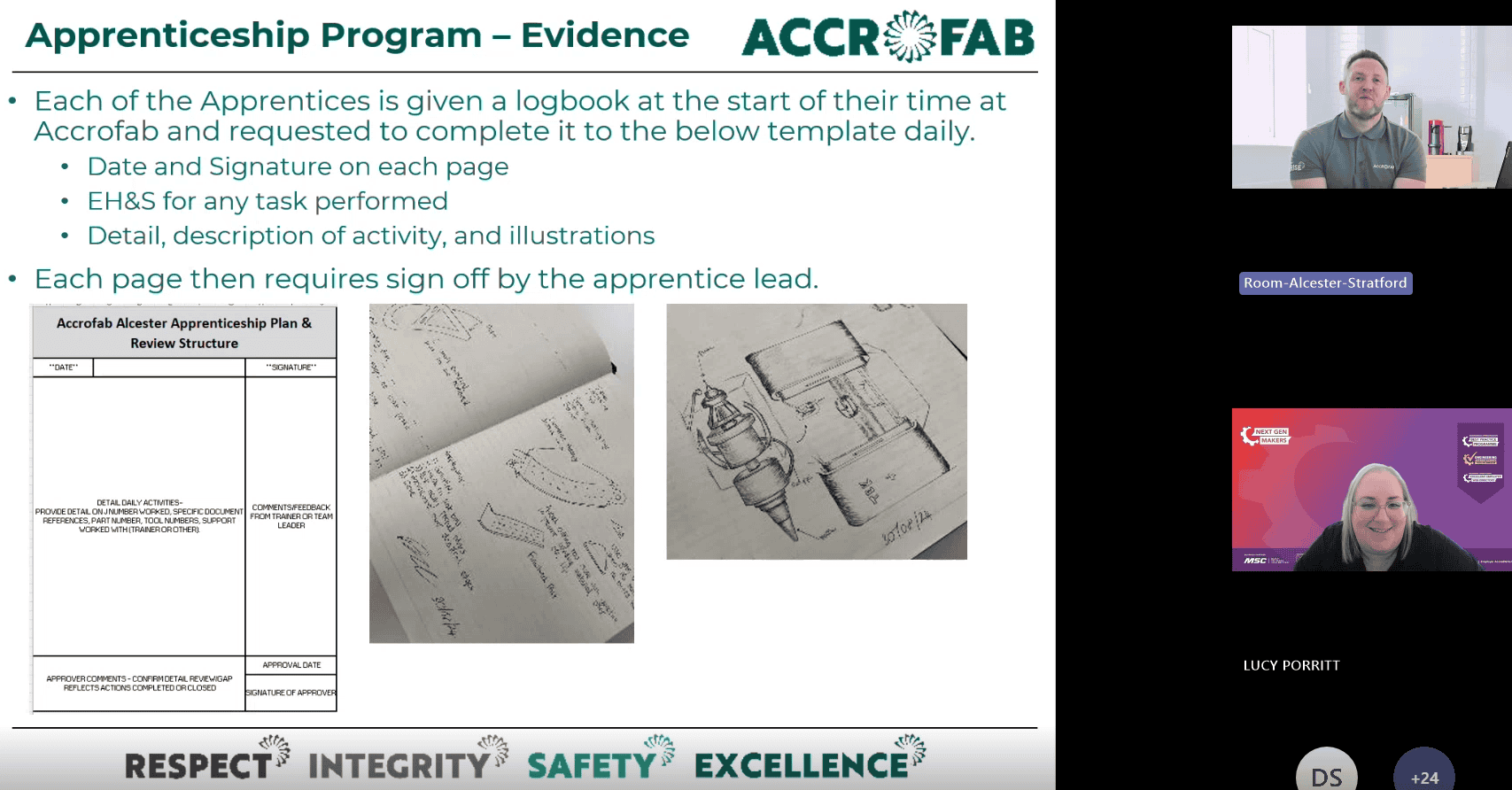
Team leader ownership gives every departmental lead a direct stake in the apprentice’s progression. It also gives the apprentice a genuine home in each area rather than being a floating resource who never quite belongs anywhere. Alongside the sign-off system, every apprentice keeps a hand-written A4 logbook. Every activity is documented: PPE worn, team-leader sign-offs required, tasks completed, illustrations of the equipment they are working on. Apprentices sign and date each page so the record is theirs. The logbooks also neatly solve a practical problem for classified customer work: where a customer’s drawings cannot be reproduced under NDA, hand-sketches of key features keep the evidence base intact without breaching customer confidentiality.
Recognition as retention
Building apprentices is only half the challenge. Keeping them is the other half. Accrofab’s approach here is worth pausing on, because unspoken retention challenges are one of the reasons the skills shortage compounds year on year.
Alongside their Rise values – Respect, Integrity, Safety, Excellence – that sit at the base of every internal slide, Accrofab operates an internal Strive Award. Managers can nominate colleagues, the platform is reviewed monthly, and quarterly recipients are put forward for director-level recognition. Winners get vouchers and a lunch with the directors.
Both of the two apprentices Finlay brought to the June meet-up, Tom Jennings and Ben Evans, had been nominated. As Ben put it during the session:
Our work never goes unrecognised.
Recognition extends beyond the internal awards. Apprentice Tom Jennings used an augmented reality welding simulator to build confidence before his first live weld, scored above 95 per cent in simulation, and then passed his physical weld test on the first attempt. He presented the case for extending the AR welding investment to Accrofab’s managing director, who approved it. Every Accrofab apprentice will now use the simulator. Apprentices are also taken to industry events, most recently the MACH Expo in Birmingham and, in July, the Farnborough International Airshow.
What this does for the skills shortage
Accrofab’s framework is not a marketing exercise – it is a structural response to a business problem.
In a five-year period during which the Ulster site grew 50 per cent by revenue, the scheme has moved from ad hoc intake to a planned pipeline of three new apprentices per year. By September 2026, Accrofab Ulster will have 11 apprentices in structured development against 101 identified competencies, with clear progression, structured recognition, and consistent apprentice voice.
That is 11 skilled engineers being developed inside the business rather than 11 gaps in the recruitment market the business needs to fill from outside. And once the framework is running, it scales. The approach can be replicated across other UK manufacturing sites, and adapted for different sector contexts.
It is also the kind of story the sector needs more of. Next Gen Makers Member Survey data underlines why. 100 per cent of members say the Apprentice Satisfaction Survey has helped them find improvements to their scheme. 95 per cent of members say the Employer Accreditation helps them to attract talent. 91 per cent say their membership is helping to inspire the next generation of engineers. One member reported changing how they recruit as a direct result of Best Practice Programme work, and receiving over 150 applicants for 6 roles this year, with excellent quality.
What is the engineering skills shortage in the UK?
The engineering skills shortage refers to the gap between the skilled engineering roles UK employers need to fill and the number of qualified candidates available in the labour market. Make UK identified 55,000 long-term unfilled vacancies in manufacturing alone in 2025, costing the UK economy an estimated £6 billion in lost output each year. 42 per cent of manufacturing vacancies are now classified as skills-shortage vacancies, up from 29 per cent in 2017.
How do engineering apprenticeships help address the skills shortage?
Well-designed engineering apprenticeships allow employers to develop the specific skills their business needs, rather than waiting for those skills to appear in the external recruitment market. They also give young people a direct route into sectors that can be difficult to access. The strongest schemes retain a significant proportion of their apprentices after completion, converting external skills-shortage risk into internal capability.
What is a competency framework in engineering apprenticeships?
A competency framework is a defined list of skills and behaviours an apprentice needs to demonstrate across their programme. Each competency requires evidence, usually observed practice signed off by a technician or team leader. Accrofab’s framework identifies 101 competencies across every process on site, with sign-off owned by the departmental team leader rather than the apprenticeship manager alone. Frameworks provide structure to what would otherwise be an ad hoc programme.
How can we start building an engineering apprenticeship scheme from scratch?
Start with strategic clarity about what skills the business will need over the next five years. Build the framework, involve departmental leaders in ownership of competency sign-off, and design in mechanisms for apprentice voice and recognition from the start. Next Gen Makers’ Best Practice Programme provides a structured route, resources and peer network. A free companion guide, How to Build an Engineering Apprenticeship Scheme from Scratch, is available on the Next Gen Makers site.
Where to start
Building or refreshing an engineering apprenticeship scheme is not a small undertaking, but it is the most direct route employers have to address the skills shortage in their own business.
Next Gen Makers’ Best Practice Programme provides the framework, resources and peer network to build an apprenticeship scheme that actually works. (100% of Next Gen Makers members would recommend membership to other employers and 95% consider the Best Practice Programme as ‘extremely valuable’.
If you would like to benchmark your current scheme against best practice, the Apprenticeship Scheme Self Assessment is a short, free starting point.