
Improving an engineering apprenticeship scheme starts with knowing exactly where the gaps are. Many employers running long-established schemes have no external reference point against which to measure their own practice, and no reliable mechanism to hear what their apprentices actually think.
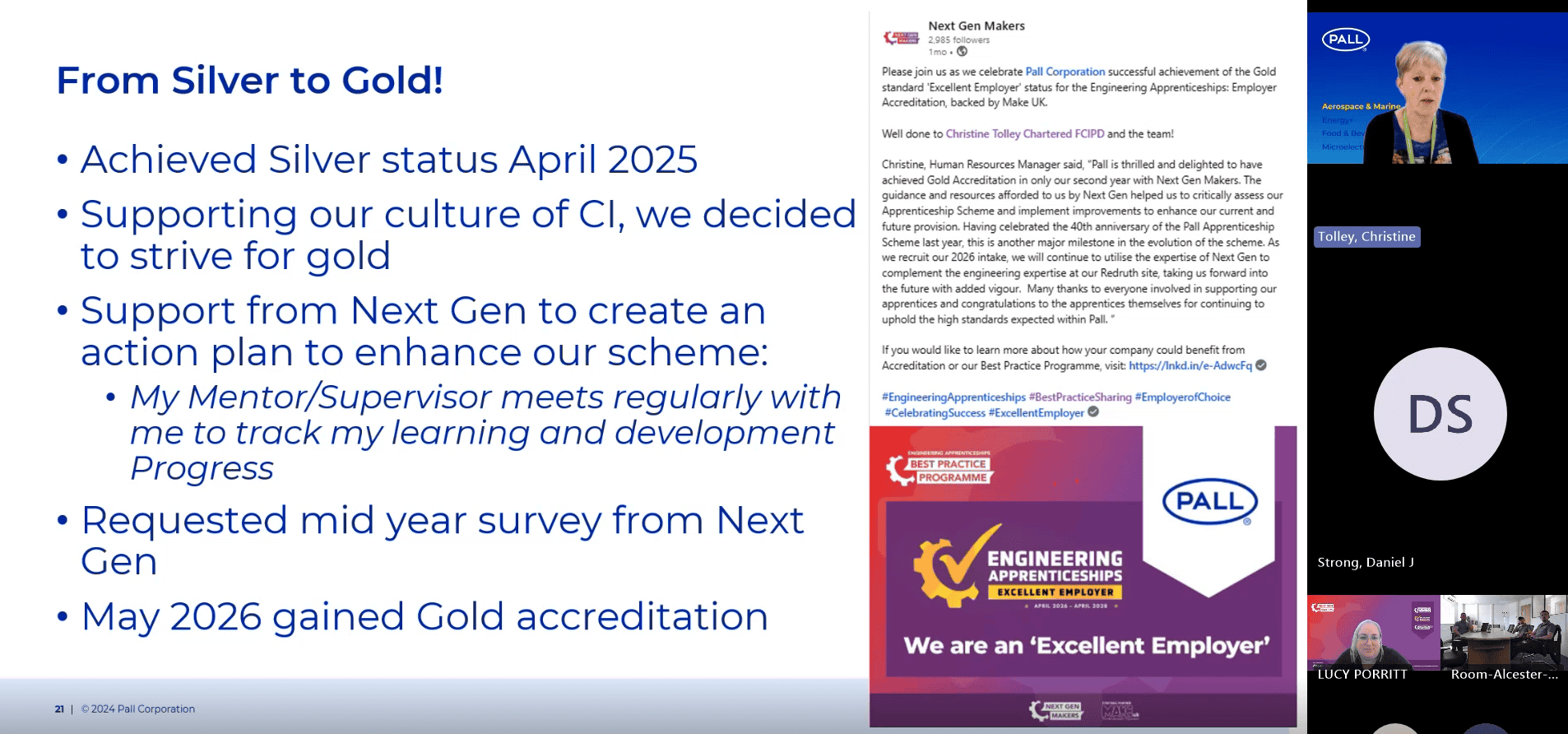
Pall Corporation‘s Redruth aerospace site had been running engineering apprenticeships since 1985. In 2025, when they benchmarked their scheme against a national standard for the first time, they missed Gold accreditation by less than one point.
Rather than settle for the strong result, they identified the specific gap. Within a single benchmark cycle they had closed it, and become the first engineering employer in Cornwall to reach Gold ‘Excellent Employer’ status.
Their successful process is great inspiration to any engineering employer running a scheme that they suspect is doing better than the results show, and to any employer running one that they know is not quite there yet.
Why external benchmarking matters for even long-running schemes
Long-established apprenticeship schemes carry a kind of internal blindness. When your scheme has been running for 10 years or more, the mechanisms introduced in year three feel like table stakes, and the gaps that have quietly opened up over time do not get noticed.
Pall Corporation’s Redruth site had been running an engineering apprenticeship scheme since 1985. It had a dedicated training centre and two full-time apprentice programme leaders, both craft apprentices by trade themselves. It had a plant manager who had come through the scheme as an apprentice. More than half of the site’s management team had come through an apprenticeship route.
By any internal measure, the scheme was strong. But it was not Gold-standard, and no one internally could have told you exactly why.
External benchmarking answers that specific question. The Next Gen Makers assessment framework, backed by Make UK, uses direct apprentice feedback to score employer schemes against defined standards for mentorship, progression, wellbeing and apprentice experience. It identifies gaps that internal reviews miss.
96% of Next Gen Makers members say the Apprentice Satisfaction Survey has given them insight they did not previously have.
The single-point gap that made all the difference
On their first Best Practice Programme benchmark, Pall Redruth missed Gold accreditation by less than one point.
As HR Manager Chris Tolley put it at the June Next Gen Makers meet-up:
It was a great wake-up call that we were actually missing an opportunity.
To address the benchmarking gap, Pall introduced monthly one-to-one mentor meetings between every apprentice and a nominated mentor. On top of that, quarterly skip-level meetings between every apprentice and the apprenticeship manager, Dan Strong.
On the mid-year retake, the scheme achieved Gold. Pall Redruth is now the first engineering employer in Cornwall to hold Gold ‘Excellent Employer’ status.
The lesson is not that mentor engagement was the specific answer… it is that specific answers only become visible when you look at the specific data.
Three habits that keep an apprenticeship scheme improving
Pall Redruth’s journey to Gold contains three top takeaways for any engineering employer:
1. Take apprentice voice at face value
The Pall benchmark result identified the mentor engagement gap because the assessment framework asks apprentices directly. Internal reviews conducted by managers rarely surface the same gaps, because apprentices, understandably, do not always tell their direct managers the whole story.
Any employer running an apprenticeship scheme should have a mechanism to capture apprentice voice that is anonymised, independent and taken seriously.
2. Act on specifics, not sentiments
When the gap was identified, Pall did not respond with a general “we will work on mentorship” statement. They introduced a specific mechanism: monthly one-to-ones with named mentors, quarterly skip-levels with the apprenticeship manager. Both are measurable, both are auditable, and both were in place before the next benchmark.
3. Do not stop when you get the result
Chris Tolley’s closing remark at our most recent member meet-up captured the mindset:
After 40 years, we still don’t want to sit on our laurels. There is lots we can be doing.
Pall Redruth has recently expanded its apprenticeship offering beyond engineering to include leadership and supply chain apprenticeships. It continues to look at how to widen its training provider partnerships in Cornwall so apprentices can experience more variety in their off-the-job learning. It supports individual apprentice interests, including mental health first-aider training, and runs community outreach across schools from primary to sixth form.
A Gold accreditation is not the end of the improvement process. It is a snapshot of where the scheme sits at one point in time. The employers who stay at Gold are the ones who keep testing themselves against the standard.
Frequently asked questions
How can we improve our engineering apprenticeship scheme?
The most effective route is external benchmarking against apprentice feedback. Internal reviews rarely surface the specific gaps that apprentices themselves see. Next Gen Makers’ Best Practice Programme benchmark, which uses direct apprentice feedback and is backed by Make UK, provides a structured route. From there, define specific mechanisms to close the gaps identified and re-benchmark to confirm the improvement.
What is Gold ‘Excellent Employer’ accreditation?
Gold ‘Excellent Employer’ is the highest tier of the Next Gen Makers Engineering Apprenticeships Employer Accreditation. It is awarded to employers whose schemes meet defined standards for mentorship, progression, wellbeing and apprentice experience, evidenced by direct feedback from current apprentices.
How does mentor engagement affect apprentice retention?
Consistent, structured mentor engagement is one of the strongest single predictors of apprentice retention and progression. When Pall Corporation introduced monthly mentor one-to-ones and quarterly skip-levels between apprentices and the apprenticeship manager, the change closed a specific benchmark gap and lifted the scheme to Gold accreditation on the retake.
How often should we benchmark our engineering apprenticeship scheme?
Annual benchmarking is the standard rhythm. Next Gen Makers offers four accreditation cycles per year, in January, April, June and October, and members can re-benchmark mid-year where a specific improvement has been made and needs verifying. Continuous improvement depends on the frequency being high enough that gaps do not linger between reviews.
Where to start
Employers who reach and hold the Gold standard are the ones who treat external benchmarking as a regular exercise, act specifically on what the feedback tells them, and do not stop when they get the result.
Next Gen Makers works with UK engineering and manufacturing employers to build and improve their apprenticeship schemes.
If you would like to explore where your own scheme sits against the standard, the Apprentice Scheme Self Assessment is a short, free starting point.