
Most apprenticeship marketing focuses on the start of the journey: Open evenings. Recruitment campaigns. Success stories about a young person getting their first qualification.
What gets discussed far less often is what happens at the other end. Where do apprentices end up? What kinds of progression are realistic? And how does that progression actually happen – the structural mechanism, not just the inspirational headline?
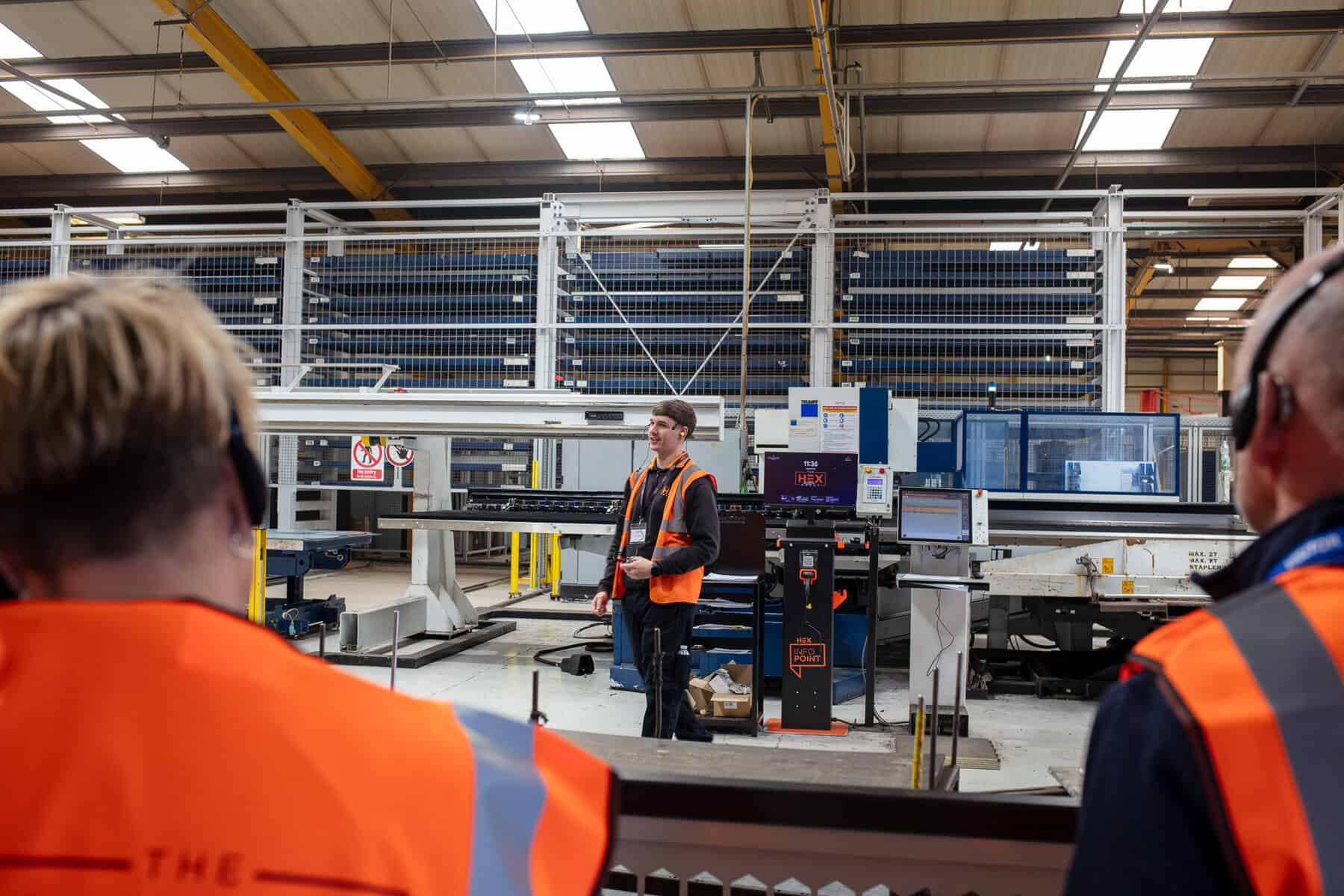
At our May member visit to The HEX Group, two former apprentices answered exactly those questions in detail. Their stories make clear what genuinely strong apprenticeship employers do that others don’t.
Ryan: 16 to Assistant Production Manager in 12 years
Ryan Williams joined The HEX Group straight from school in 2012, at 16. He’s now 29, Assistant Production Manager, and leads a team of around a hundred people across production lines, line leaders and team leaders in Bri-Stor : the group’s vehicle conversions business.
His route through those 12 years is worth following in detail:
- Two-year apprenticeship across all three of the group’s businesses at the time. Six months in some departments, a week in others. “What you see in a week, you wouldn’t see in a year of being there full-time.”
- Finished the apprenticeship three months early to take a Continuous Improvement role at 17
- Spent two to three years on improvement projects: warehouse redesigns, 5S audits, sub-assembly lines, picking tracker rollouts
- At 21, asked to step onto the production line during a 1,200-vehicle PT contract. Promoted to team leader shortly after
- Promoted to group leader during COVID, stepping up when senior colleagues couldn’t return
- Promoted to Assistant Production Manager at 28, after stepping up during a senior absence and being given the role permanently on return
Ryan’s reflection is worth quoting directly:
“I haven’t been a fitter for years. Some people have worked here 20, 30 years – they’re probably looking at a young lad that sat in an office for two years, and now he’s on the line telling them what to do. So I was a bit nervous at the start, but not for long, because you’re soon getting respected for not being afraid to get your hands dirty.”
Rhys: 16 to Technical Sales Manager in 6 years
Rhys Smith joined at 16, also straight from school. He’s now Technical Sales Manager at Alpha Manufacturing — the group’s sheet-metal fabrication business – responsible for bringing in all new customers and the growth side of Alpha.
His route:
- First-year apprentice rotation: hands-on training in welding, fabrication, milling and lasers, with two months per area
- Year two: identified through the rotation plan to step up and cover for a retiring colleague. Took on the role of Atlas Coatings Coordinator at 17/18 – managing orders, customers, purchase orders, and covering for the production manager during annual leave
- Won Apprentice of the Year at the group awards
- Moved into a brand-new role at HEX Living – three direct reports, weekly meetings with the operations director and MD. Won the HEX Group Outstanding Employee award
- Moved into Technical Sales at Alpha, his current role
What’s striking is that Rhys hadn’t decided he wanted to be in sales when he started. The route revealed itself.
“Working directly with customers and working in sales when we did so many shows, I decided I’d like to have a go at sales — utilising my background in technical knowledge.”
The pattern: rotation as a discovery mechanism
Both stories share the same structural feature.
The HEX Group’s first-year apprentice rotation isn’t only a training tool. It’s a discovery mechanism: both for the apprentice (who finds out what they enjoy and where they fit) and for the business (which spots specific strengths and matches them to specific business needs).
Karen Barnacle (People & Culture Director) put it directly: “It’s quite organic really. During the three-year programme we sort of spot these people. And often we’ll take them off the scheme so they’ll carry on doing their apprenticeship, but actually we’ll move them into the role early.”
Both Ryan and Rhys describe being promoted before formally completing their apprenticeship. Both continued their qualifications alongside the new role – with classroom time protected and weekly coursework support.
‘Organic but deliberate’: how managers spot talent
This pre-completion promotion model surprised one member of the visiting group, who works in a larger corporate organisation:
“I have some challenges from being in a very large organisation. The central team says no – they have to do another programme, you can’t force it. How do you manage to do that?”
Karen’s answer was illuminating:
“It’s slightly easier for us because we’re not corporate. I’m actually on the board now, which is massive for us. So we’ve got a voice on the board, and everybody’s based on this site, so we can make decisions more quickly.”
For corporate engineering employers, the lesson isn’t to abandon HR governance. It’s to ask whether your governance structure can move at the speed individual apprentices need it to. If a 19-year-old is ready for a role two years into their apprenticeship, can your structure accommodate that?
For many large engineering employers, the honest answer is “not yet.” That’s a structural question worth taking back to leadership.
The relationship advantage no campaign can replicate
The point Ryan ends on isn’t about job titles. It’s about the relationships the rotation built:
“There’s people that work in Bri-Stor that have worked there 20 years – they’ve probably never even been in Alpha. I’ve been here 13 years and I’ve worked in every department. I’ve moved with people, I know who’s done what. That relationship has helped me to stay in my job today. I wouldn’t change that for anything.”
It’s the kind of compound benefit that doesn’t show up on a recruitment dashboard. It also tends to be the reason apprentices stay, become managers, and stay again.
What this means for engineering employers
Strong engineering apprenticeship progression isn’t accidental.
It comes from three structural choices: a rotation programme that genuinely exposes apprentices across the business, managers actively watching for who fits where, and a governance structure that can move someone into a real role before their formal qualification is complete.
The HEX Group has been doing all three for 15 years. The result is two former 16-year-olds leading material parts of the business – and an apprentice cohort that can see a credible path to genuinely senior roles.
👉 Get in touch to explore what apprenticeship progression could look like in your organisation.