
The UK engineering and manufacturing sector is currently navigating a period of profound transition. While the demand for technical innovation has never been higher, the talent pool remains frustratingly shallow. Most engineering employers we speak with reiterate the same core concern: “We simply cannot find enough diverse talent to fill our vacancies.”
The figures are well-documented and sobering. To keep pace with current demand and technological advancement, the UK requires an estimated 173,000 new engineers and technicians annually. Despite decades of outreach, the diversity gap remains a chasm; women currently hold roughly 17% of engineering roles, a stark contrast to the 28% they represent in the wider manufacturing workforce.
However, at Next Gen Makers, we believe that framing this challenge purely as a recruitment problem is, at best, a half-truth. At worst, it is a strategic error that leads firms to solve the wrong problem entirely. The real crisis may not be who you are failing to hire, but who you are failing to keep.
The Reframe Most Employers Haven’t Made Yet
During a recent member meet-up, Poggy Murray-Whitham, COO of Divrsity (the UK’s leading DEI survey and data platform), posed a question that fundamentally challenged the room: “What if the talent problem we face isn’t just who we’re struggling to recruit: but who we’re struggling to keep?”
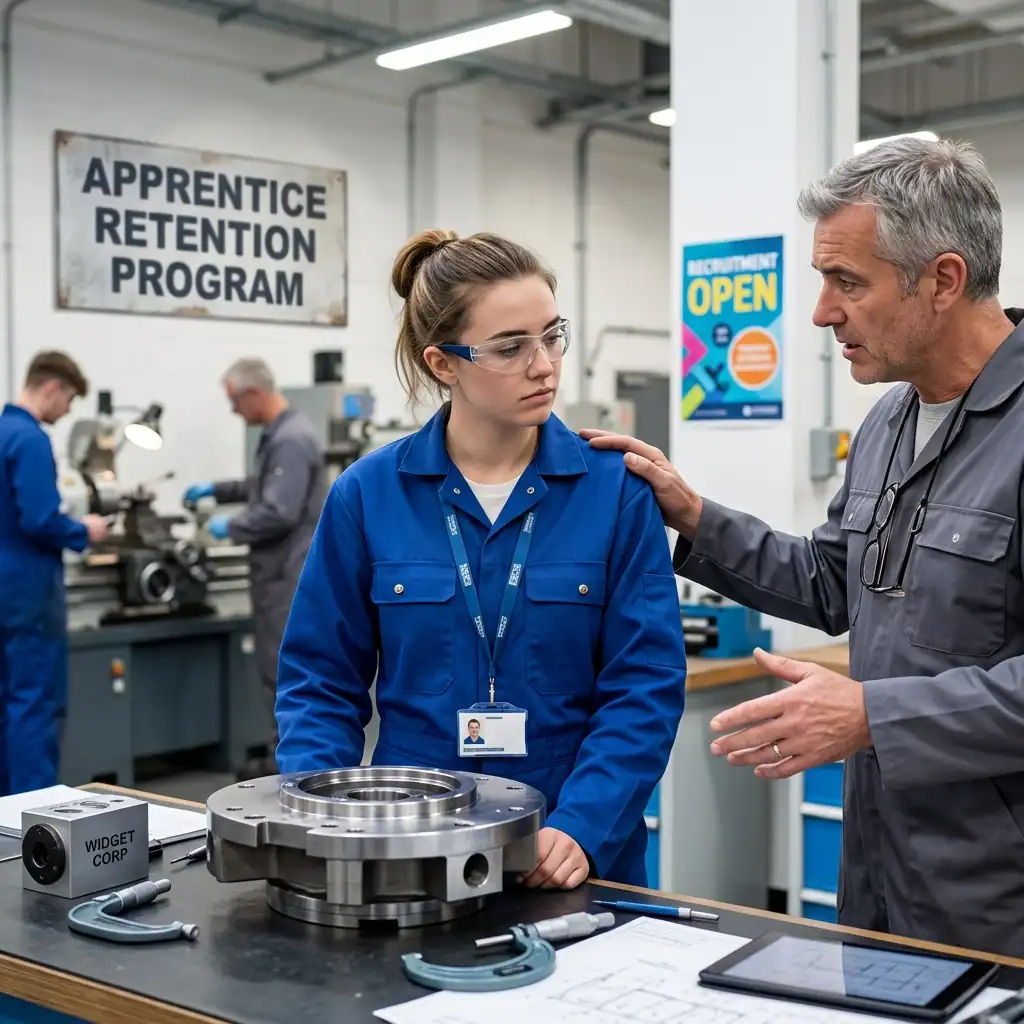
This shifts the focus from the ‘top of the funnel’ (attraction) to the ‘lifecycle’ (retention). If your organisation invests heavily in attracting diverse candidates for engineering apprenticeships but fails to provide the culture or support necessary to see them through to completion, you aren’t building a pipeline: you are managing a leaky bucket.
The data backs this reframe up with startling clarity. Between 2022 and 2023, the number of women in engineering and technical roles in the UK fell by 38,000 in a single year. Despite years of government and industry investment in STEM attraction, the proportion of women working in the sector actually decreased. This suggests that while we are getting better at opening the door, we are failing to ensure the environment inside is one where diverse talent can thrive.
Most engineering employers we work with say the same thing: “We can’t find enough diverse talent.”
It’s a real problem. The UK needs an estimated 173,000 new engineers and technicians a year to keep up with demand. And the diversity numbers are still stark — women hold around 17% of engineering roles, despite making up 28% of the wider manufacturing workforce.
But framing the challenge purely as a recruitment problem is, at best, half the story. At worst, it’s solving the wrong problem entirely.
That was the central argument made by Poggy Murray-Whitham, COO of Diversity (the UK’s leading DEI survey and data platform), at our recent member meet-up — and it’s an argument worth taking seriously.
The cost employers don’t always see
Replacing experienced engineering talent isn’t cheap. Recruitment fees, onboarding time, lost productivity, disrupted teams, and the time it takes for a new hire to come fully up to speed can run to six months’ salary or more — significantly more for specialist roles.
That’s the visible cost. The invisible cost is what gets lost while the role sits unfilled or under-performed: missed innovation, slowed projects, lost institutional knowledge, and the compounding effect on the colleagues who stay.
Stop guessing. Start measuring.
The most useful part of Murray-Whitham’s session was honest. He told the room directly: “I don’t know what your people are experiencing. I don’t know whether your issues are culture, progression, management, flexibility, or something else entirely. Me not knowing that is fine. What becomes worrying is if you don’t know either.”
His argument: employers wouldn’t redesign a production line without first understanding how it’s working. Yet most attempt to redesign their people systems on instinct.
If you’re serious about building a more diverse and resilient engineering pipeline, he suggests measuring across five areas of the talent lifecycle:
- Attraction
Who actually sees you, and what do they see? Are you advertising in the same places that already produce the same applicants? Can candidates from underrepresented groups see people like them succeeding in your business?
- Recruitment
Who gets through the door, and where do certain groups disappear from your funnel? Is “culture fit” doing more work in your hiring decisions than it should? Are unstructured interviews rewarding confidence over competence?
- Retention
Who joins but doesn’t stay? Are there managers or teams with consistently higher turnover? What do exit interview themes tell you — and how many of those conversations are happening too late to act on?
- Progression
Who gets promoted, sponsored or invited to high-visibility work? Are some people having to over-perform to receive the same recognition? Many organisations diversify entry-level intake but quietly homogenise leadership over time.
- Experience
Two people on the same team, with the same manager, can experience two completely different workplaces. That gap drives everything else — retention, performance, wellbeing, progression.
Why this matters now for engineering employers
Three things are happening at once. Demand for engineering skills is rising. The workforce is ageing — 36% of UK manufacturing workers are now over 50. And competition for diverse talent is intensifying as more sectors invest in inclusive hiring.
Employers who continue to focus only on attraction will keep filling the top of a leaky funnel. Those who measure across the full lifecycle — and act on what they find — will build pipelines that compound.
Where to start
If you don’t yet have lifecycle data, the simplest first step is benchmarking your apprenticeship scheme against what good looks like in engineering and manufacturing. It won’t tell you everything; but it will tell you where to look.
Our Apprenticeship Scheme Self Assessment gives engineering employers a structured way to assess their scheme against industry best practice, identify the gaps that matter, and build evidence-led plans for what to change next.
Strong apprenticeship schemes deserve formal recognition. But before you can recognise excellence, you have to understand where you stand.