
Most discussions about how to attract diverse engineering apprentices feature plenty of employers – and few apprentices.
That’s a problem. Because the people best placed to tell engineering employers what attracts diverse talent are the diverse apprentices who actually applied.
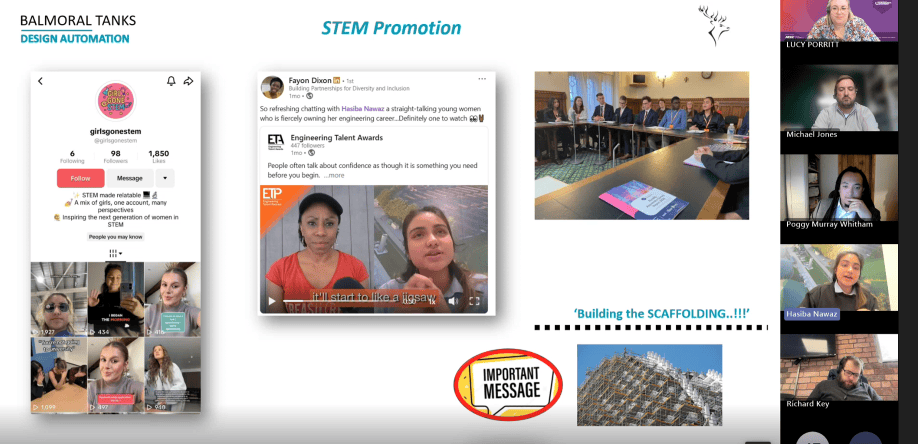
At our recent member meet-up, we heard from one of them. Hasiba Nawaz completed a Level 3 advanced manufacturing engineering apprenticeship at Balmoral Tanks, was named in The Manufacturer’s Top 100 list in 2025, and is about to start a Level 6 product design and development degree apprenticeship.
She’s also a young Pakistani woman in a sector where she had no role model in her family or community telling her engineering was an option.
What follows is shaped by what she said employers got right – and what nearly stopped her applying in the first place.
1. Work experience as a ‘taste test’
Nawaz is unambiguous about which single intervention matters most: meaningful work experience.
“You wouldn’t buy an ice cream you’d never tasted. Work experience is the same. You have a little sample. You either think ‘this is for me’ — or you don’t. Either way, the decision is informed.”
Of the four students Nawaz has personally hosted on placements at her company, three decided engineering wasn’t for them. One went on to pursue an apprenticeship.
That’s not a failed conversion rate. That’s four young people making informed decisions, instead of self-selecting out of engineering based on assumption.
For employers wondering where to focus their early-careers attraction effort, the implication is clear: meaningful, structured work experience does more to widen who applies than almost any marketing campaign, especially for candidates who have no one in their network telling them this sector is for them.
2. Visibility on the platforms young people actually use
Nawaz’s second observation lands differently depending on the age of the person hearing it.
“You don’t pick up a newspaper and read it to find opportunities. It’s all on social media. So why don’t more engineering businesses have a TikTok page?”
For employers whose social presence is limited to LinkedIn and a quarterly company blog, this is uncomfortable. But it’s accurate.
Young people researching engineering careers spend time on TikTok, Instagram and YouTube — not on careers fair landing pages. Employers who want to be considered by a wider, more diverse pool need to be visible where consideration actually happens.
This isn’t an argument for performative content. It’s an argument for showing up authentically in the spaces young people already use to research the world of work.
The data from elsewhere in the same meet-up reinforces the point. Merlin Entertainments’ 2026 social campaign generated 234,500 views and 1,214 registrations of interest from young people for 4 apprenticeship roles. That kind of reach doesn’t happen on a careers page.
3. Day one: a clear pathway and a named person to ask
Nawaz spoke about a job offer being only the beginning of the journey — not the end. What kept her in the sector was structure, not luck.
“Once you come into the business, having one person you know you can go to — that’s everything. Even if it’s just ‘I need help with this’ … knowing where to ask makes the difference.”
This echoes a point made by other speakers at the same session: support has to be designed in, not assumed. Visual timelines. Named mentors. Clear progression conversations. Adjustment prompts offered before they’re requested.
For employers, the practical implication is small but powerful: every apprentice should know, on day one, what the next 12 months looks like, and who they go to when something doesn’t make sense.
It’s the kind of detail that’s easy to skip, and disproportionately costs employers their most underrepresented hires when they do.
A reframing of failure
The most quotable thing Nawaz said wasn’t about employers at all. It was about mindset:
“People think success is either win or fail. It’s not. It’s fail, fail, fail, and eventually you win. Failing is part of success.”
It’s a useful corrective for employers too. Attracting and retaining diverse apprentices isn’t a one-campaign challenge. The employers who get there will be the ones willing to test, learn, adjust, and try again.
What this means for engineering employers
Three things to consider this term:
- Open your work experience programme up wider. Even one structured placement per term will widen the pool of young people making informed decisions about your sector.
- Audit your social presence honestly. Are you visible where 16-year-olds actually look — or only where 40-year-olds expect them to?
- Design the first 90 days with the same rigour as the recruitment process. Named contact, visual pathway, regular check-ins. The retention battle is won here.
The route into engineering is changing. Employers who listen to apprentices like Nawaz — and design accordingly — will be the ones young diverse talent chooses.
👉 Download our guide to discover what Apprentices ACTUALLY want.